

Every realtor has an incentive to tell you buying beats renting. I get that. So let's set that aside and actually run the numbers honestly — because sometimes renting is the right call, and pretending otherwise doesn't serve you.
Here's how to actually think about it, not the sales-pitch version.
The Numbers Nobody Compares Correctly
The mistake most comparisons make is stacking your full mortgage payment against your rent. That's not a fair comparison — a big chunk of your mortgage payment is going toward building equity you keep, not just paying for shelter like rent does.
A fairer comparison looks at four things:
- Cash cost to occupy — rent, or the interest + property tax + insurance + condo fees portion of owning (the part you don't get back)
- Equity building — the principal portion of your mortgage payment, which is really forced savings
- Upfront costs — down payment, closing costs, and what that money could have earned elsewhere
- Flexibility cost — what it costs you to be able to move on short notice
Renting wins on some of these. Buying wins on others. The right answer depends on your specific numbers and your specific life, not a blanket rule.
Where Calgary Sits Right Now (July 2026)
The math above isn't theoretical — it depends on actual market conditions, and those shift. Here's where Calgary stands as of the latest CREB figures:
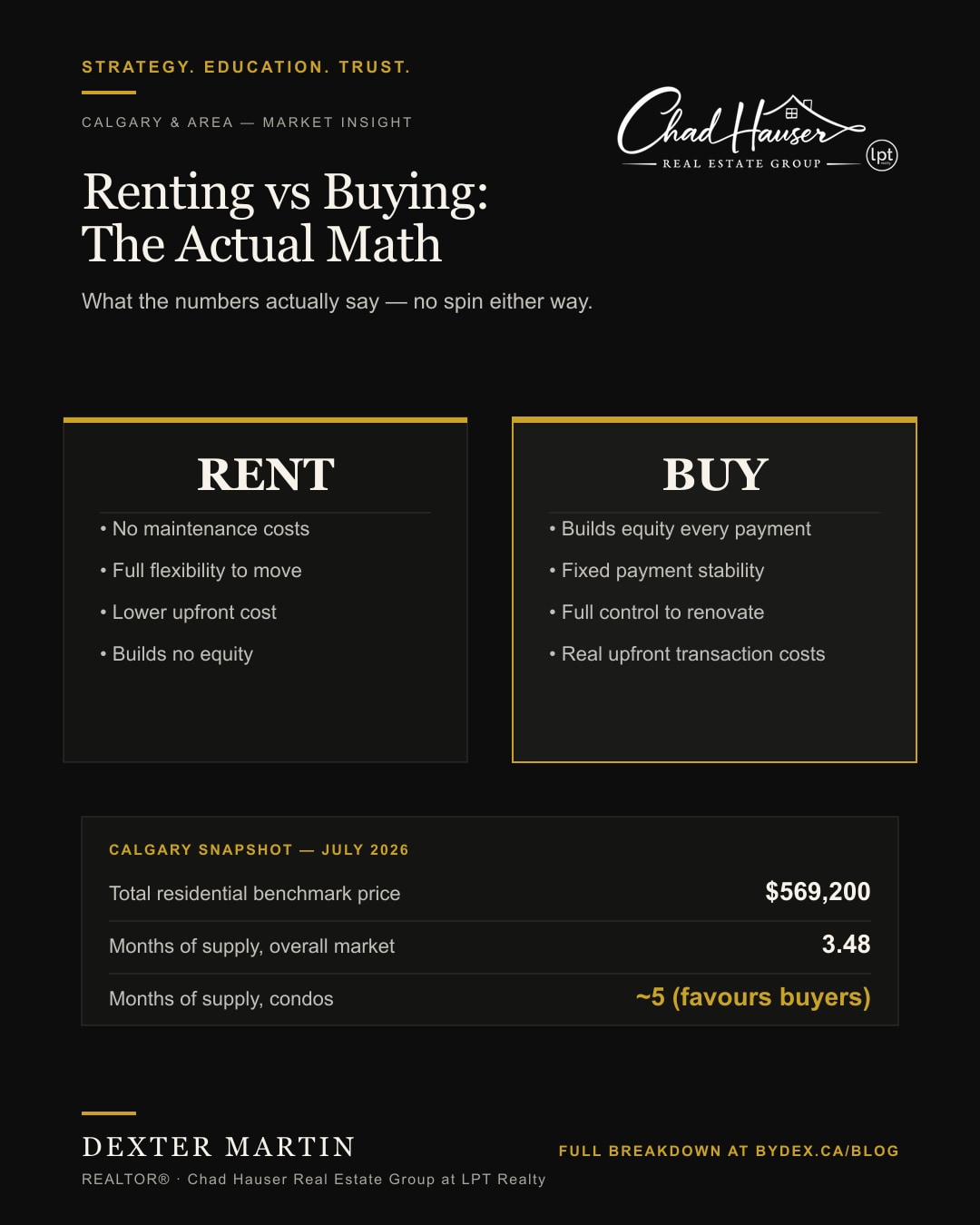
- Total residential benchmark price: $569,200, down 2% year-over-year
- Months of supply: 3.48, up from a tighter market a year ago — this is a more balanced-to-buyer's market than Calgary has seen in a few years
- Detached benchmark: $743,900 (down ~2% Y/Y), months of supply around 2.9 — still relatively balanced, not a steep buyer's market
- Apartment/condo benchmark: $297,600 (down over 8% Y/Y), months of supply near 5 — this segment has clearly shifted in the buyer's favour
What that means practically: if the “rent vs. buy” math has felt out of reach for the last couple of years, condos and row homes specifically have gotten more favourable — both on price and on your ability to negotiate. Detached homes have softened too, but less dramatically. This doesn't change the personal-finance side of the decision (your timeline, your down payment, your risk tolerance), but it does mean the “buy” side of the math is a bit stronger right now than it was in 2023–2024, especially for condo buyers.
Where Renting Actually Wins
You're not staying put. If there's a real chance you move cities, change jobs, or need flexibility within 2–3 years, renting usually wins outright. Buying has real transaction costs on the way in and the way out (legal fees, realtor commissions if you sell, land transfer costs) — those costs need time to be absorbed by appreciation and equity paydown. Sell too soon and you can come out behind even in a rising market.
Your down payment isn't really ready. If getting to a down payment means draining your entire emergency fund, or stretching into a mortgage that leaves zero room for life, renting while you build a real cushion is the financially sound move — not the “giving up” move.
You value not being responsible for repairs. This is a real, legitimate preference, not just an excuse. Owning means you're on the hook for the furnace, the roof, the sewer line. Some people genuinely prefer paying rent and calling a landlord instead of budgeting for a $9,000 roof replacement.
Renting frees up capital that could be invested elsewhere. If you're disciplined enough to actually invest the difference between renting and owning — not just spend it — a diversified investment portfolio can, in some periods, outperform real estate appreciation. This only works if you genuinely invest the gap instead of letting it evaporate into lifestyle spending, which is the part most people underestimate about themselves.
Where Buying Actually Wins
You're staying 5+ years. This is the single biggest factor. The longer you hold, the more the upfront transaction costs get diluted, and the more of your payment goes toward principal instead of interest. Five years is a reasonable rule-of-thumb break-even point in most Calgary scenarios; less than that, run your specific numbers carefully.
You want payment stability. A fixed-rate mortgage means your core housing payment doesn't move for the term, while rent in a market with tightening vacancy can climb every renewal. That predictability has real value, especially if you're planning a family or a long-term budget.
You want to build equity in something you control. Every mortgage payment builds equity that's yours — money you can eventually use for your next home, retirement, or just financial flexibility. Rent payments build zero equity, full stop. Over a decade, that difference is substantial.
You want the ability to actually make it yours. Renovate the kitchen, paint the walls, get a dog without asking permission. That's not just emotional — it's part of why homeowners tend to report higher satisfaction with their living situation over time, even accounting for the financial trade-offs.
A Simple Way to Run Your Own Numbers
You don't need a spreadsheet with forty tabs. Three questions get you most of the way there:
1. What's my realistic timeline? Under 3 years, lean renting unless your circumstances are unusual. Over 5 years, the math increasingly favours buying. In between, it depends on the next two questions.
2. What's the gap between my rent and my full ownership cost? If a comparable home would cost you significantly more per month to own than to rent, and you wouldn't actually invest the difference, the “buy” case weakens. If the monthly gap is small, or rent is climbing faster than ownership costs would, the case for buying strengthens.
3. Would my down payment leave me financially exposed? If buying now means zero cushion for a job loss, a major repair, or a life surprise, that's not a good financial position regardless of what the long-term math says. Financial stability comes first.
Buying isn't automatically the smart choice. Buying when it fits your timeline, your finances, and your life is the smart choice.
The Middle Ground Nobody Talks About
This isn't always a binary decision made once. Plenty of people rent for another year or two intentionally — to finish paying down debt, to build a bigger down payment, to wait out a job transition — and then buy with a much stronger financial position than if they'd rushed into ownership. That's not failure to launch. That's sequencing the decision correctly.
Other people buy something smaller or in a different neighborhood than they'd ideally want, specifically because the math and the timeline both work, and they'd rather start building equity now than wait for a “perfect” home that may never show up on schedule.
Both are reasonable strategies. What's not reasonable is buying because you feel like you're “supposed to” by a certain age, or renting indefinitely out of fear without ever running the actual numbers.
Ready to Run Your Actual Numbers?
Generic rent-vs-buy calculators online are a decent starting point, but they don't know your specific situation — your timeline, your risk tolerance, the actual homes you're considering, or what you'd realistically do with the difference if you rented instead.
I'll walk through your real numbers with you, no spin either direction. Sometimes that conversation ends with “you should keep renting for now” — and that's a completely legitimate outcome of a good consultation.
DM me or book a consultation call. Let's figure out what actually makes sense for you.
