

You've made an offer. It's conditional on inspection. The inspector shows up, spends three hours crawling through attics and basements, and hands you a 40-page report with photos of every imperfection in the house.
Your stomach drops. Cracked caulking. A slightly uneven floor. An electrical panel that's “aged.” Water staining on a joist from 2011. It reads like the house is falling apart.
It's not. Almost every home — including the one you're living in right now — would generate a report like this. The question isn't “does this report have issues on it.” It's “which of these issues actually matter.”
Here's how to read it like someone who's seen a hundred of them, not someone seeing their first one at 9 PM after a long day.
Why Every Report Looks Alarming
Inspectors are trained — and legally incentivized — to document everything. Their job isn't to tell you whether to buy the house. It's to tell you the condition of every visible, accessible system, so nothing is a surprise later.
That means a 60-year-old furnace that's running perfectly fine still gets flagged as “nearing the end of its expected service life.” A hairline foundation crack that's been stable for 30 years still gets photographed and noted. None of that means the house is a bad buy. It means the inspector did their job.
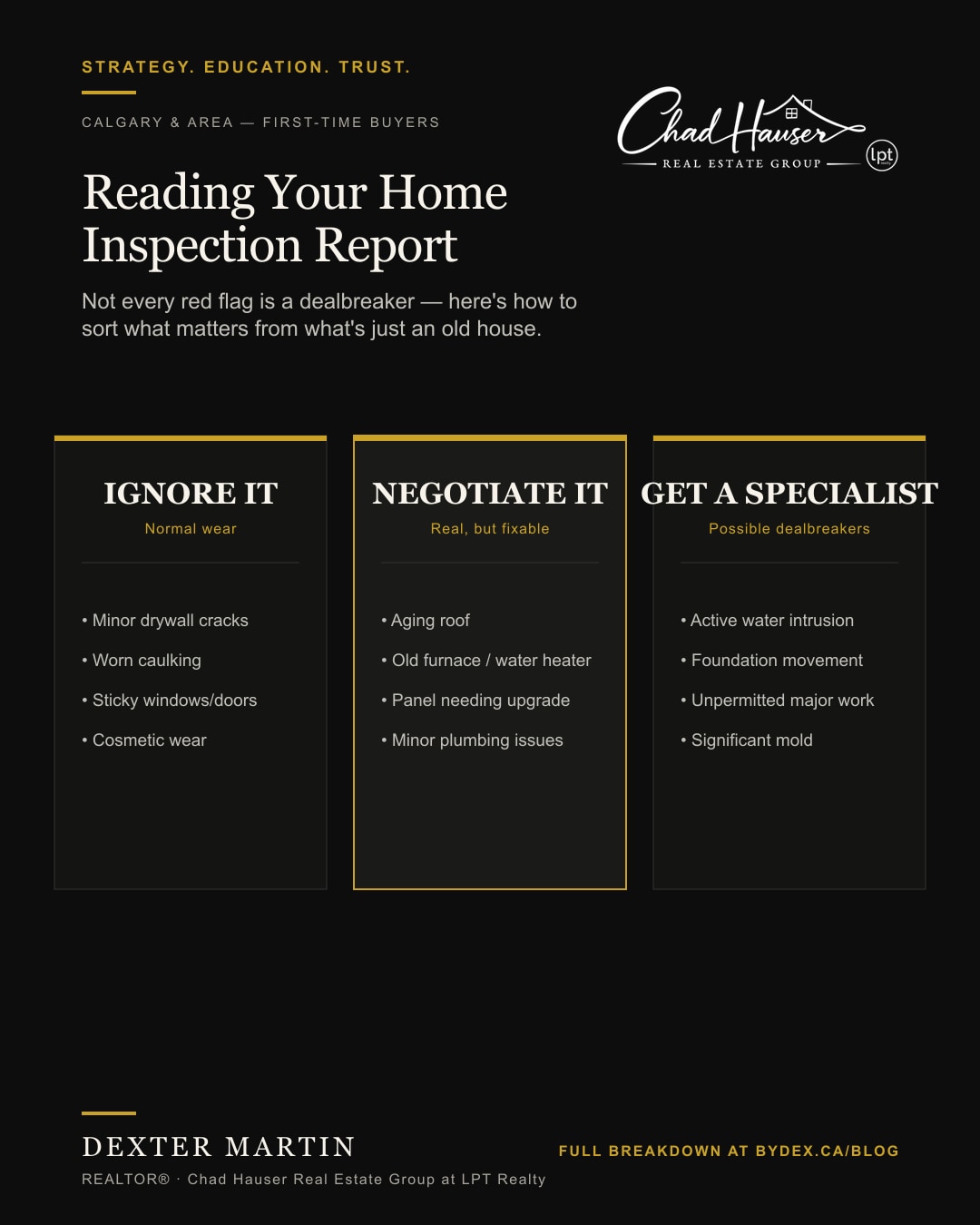
Your job — or mine, working with you — is to sort the report into three piles: ignore it, negotiate it, and walk away over it.
Pile 1: Normal Wear — Ignore It
These show up on almost every report for almost every house, and they're not worth a renegotiation:
- Minor drywall cracks, especially near doorways and windows (normal house settling)
- Worn caulking around tubs, sinks, and windows
- Small nail pops or texture inconsistencies
- Slightly sticky windows or doors
- Cosmetic wear on flooring, paint, or fixtures
- A water heater or furnace that's older but still functioning and within its expected lifespan
- Minor grading issues that don't show evidence of actual water intrusion
If your inspector's report is ten pages of this kind of thing, that's actually a good sign — it means there's nothing structurally or mechanically concerning to talk about.
Pile 2: Negotiating Chips
These are real, they cost real money, but they're rarely reasons to walk. They're reasons to have a conversation — either a price reduction, a seller-paid repair, or a credit at closing.
Roof nearing end of life. Not leaking, not damaged, just old. A 20-year-old asphalt shingle roof with a 20–25 year expected lifespan isn't an emergency, but it's a real future cost — reasonable to ask for a credit reflecting a portion of replacement cost.
Aging furnace or water heater. Same logic. If it's working now but clearly near end-of-life, it's a legitimate ask for a credit, not a reason to cancel.
Electrical panel needing an upgrade. Older panels (some fuse-based systems, certain older breaker brands) can be a genuine insurance and safety consideration. Get a quote from an electrician before you negotiate — this is one where the actual dollar figure matters more than the description.
Minor plumbing issues. A slow drain, an old shutoff valve, a minor drip under a sink. Fixable, usually cheap, worth a credit rather than a dealbreaker.
Deck or fence in poor condition. Cosmetic and structural wear on secondary structures. Real cost, rarely urgent.
Pile 3: Actual Dealbreakers (Or At Least “Get a Specialist In Here”)
This is the short list of things that should genuinely change your decision, or at minimum trigger a follow-up inspection from a specialist before you go any further:
Active water intrusion. Not old staining — active moisture, visible mold, or evidence of ongoing leaks into the basement or foundation. This needs a specialist assessment before you proceed at all.
Foundation movement, not just cracking. Cracks alone aren't automatically serious — nearly every foundation has some. What matters is whether there's evidence of ongoing movement: doors and windows that won't close properly, cracks that are actively widening, visible bowing or shifting. That needs a structural engineer, not just a second opinion.
Knob-and-tube or aluminum wiring throughout. Some older Calgary homes still have this. It's an insurability problem as much as a safety one — some insurers won't cover it, or will charge significantly more. Worth knowing before you're committed.
Significant mold beyond a bathroom fan issue. A little mold around a poorly ventilated bathroom exhaust is common and fixable. Mold that suggests a chronic moisture problem in the walls or structure is a different conversation entirely.
Major structural modifications without permits. A removed load-bearing wall, an unpermitted basement suite, an addition that was never inspected by the city. These can become expensive problems at resale, or even insurance and legal issues now.
What I Do Differently As Your Advisor
Most agents forward you the inspection report and let you figure it out. That's not enough for a decision this size.
When my clients get their inspection report, we go through it together — line by line if needed. I've seen enough of these to know within a few minutes which items are genuinely worth a conversation with the seller and which are noise. Then we build the actual negotiation: what to ask for, how to frame it, and what's realistic to expect back.
Sometimes that means going back to the seller for a credit. Sometimes it means walking away from a house that looked perfect in photos but has a real structural issue underneath. Sometimes — most times — it means telling you the report looks scarier than it is, so you don't lose a good home over normal wear and tear.
The goal of an inspection isn't to find a reason to walk away. It's to make sure you know exactly what you're buying.
Your Inspection Day Checklist
- Attend the inspection if you can — seeing issues in person is worth more than reading about them later.
- Ask the inspector questions directly. “Is this urgent or cosmetic?” is a fair thing to ask on the spot.
- Don't panic-read the report alone at midnight. Wait, and go through it with someone who can help you sort priority from noise.
- Get specialist quotes for anything in the “negotiating chips” or “dealbreaker” categories before you decide what to ask for.
- Decide what actually matters to you — not just what's technically wrong, but what you're willing to live with.
Ready to Make Sense of Your Inspection Report?
If you're mid-transaction right now staring at a report that feels overwhelming, or you just want to know what to expect before you get there, let's talk it through.
I'll help you separate what's actually a problem from what's just an old house being an old house — and make sure whatever you decide, you're deciding with clear eyes, not panic.
DM me or book a consultation call. No pressure, just clarity.
