

Most first-time buyers think they need 20% down to buy a home. It's the number everyone talks about—friends, family, that one uncle at Thanksgiving. But here's what they don't tell you: 20% isn't a requirement. It's a benchmark.
In Alberta, you have real options. And choosing the right one will shape your entire first-year homeownership experience. Not just financially, but mentally too.
Let's break down your actual choices, what each one costs you, and how to pick the one that makes sense for your situation.
The Reality of Down Payments
First, the baseline: your down payment is the money you bring to the table on day one. The rest? You borrow via mortgage.
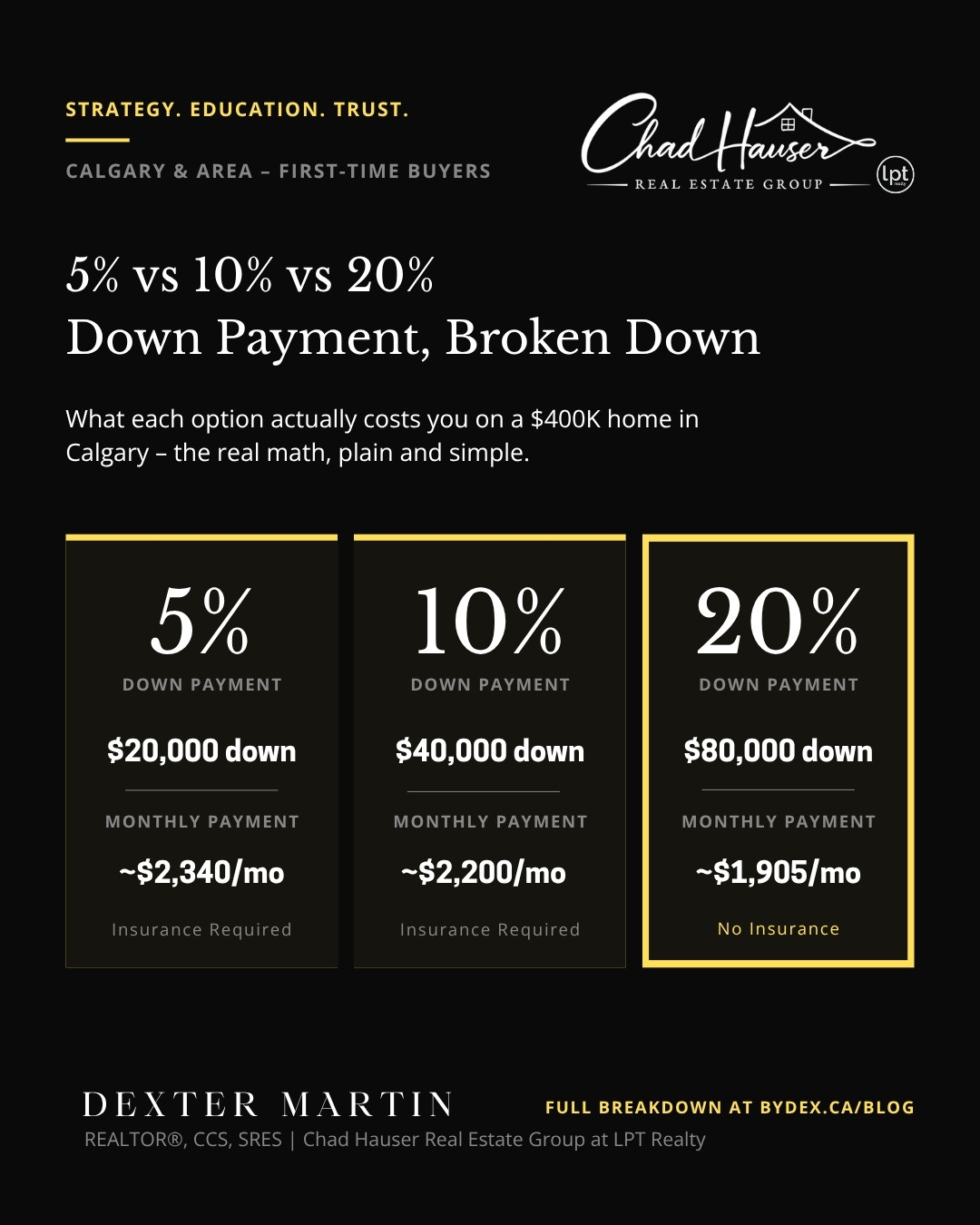
If you find a $400,000 home in Calgary:
- 20% down = $80,000 out of pocket
- 10% down = $40,000 out of pocket
- 5% down = $20,000 out of pocket
The difference is huge. But here's what most people miss: it's not just about what you pay upfront. It's about what you pay over the next 25 years.
Let me walk you through each option so you can see the full picture.
Option 1: 5% Down (The Minimum)
What it means: You borrow 95% of the home's value.
The upside:
- Lowest barrier to entry. You need the least amount of savings.
- You keep more cash on hand for closing costs, emergencies, or renovations.
- You get into the market faster while prices do what they do.
- Still builds equity from day one.
The cost (and this matters):
- You pay mortgage insurance. This is mandatory because the lender is taking on extra risk.
- In Alberta, mortgage insurance typically runs 3.5–4% of your mortgage amount.
- On a $380,000 mortgage (5% down on a $400k home), that's roughly $13,300 in insurance costs, rolled into your mortgage.
- Your monthly payment is higher because you're borrowing more.
- That insurance stays on your mortgage until you hit 20% equity (usually 5–7 years in, depending on appreciation).
Real example: $400,000 home, 5% down in Calgary.
- Down payment: $20,000
- Mortgage: $380,000
- Mortgage insurance: ~$13,300
- Total borrowed: $393,300
- Monthly payment (at 5.5% over 25 years): ~$2,340
Who should consider this:
- You're confident about your income and can handle the slightly higher payment.
- You want to preserve cash for other priorities (renovations, emergency fund, life happens).
- You believe the home will appreciate (Calgary has been solid for appreciation in key neighborhoods).
- You're planning to stay for at least 5 years (gives time for equity to build and rates to potentially shift).
The timeline caveat: Once you hit 20% equity in your home, you can ask your lender to remove mortgage insurance. In appreciating markets, that might happen faster than your amortization schedule predicts.
Option 2: 10% Down (The Middle Ground)
What it means: You borrow 90% of the home's value.
The upside:
- Mortgage insurance is still required, but lower than 5% down.
- You have more skin in the game, which lenders like (slightly better rates possible).
- You're not house-poor. You've got breathing room in your budget.
- Still significantly less upfront than 20%.
The cost:
- Insurance runs 2.5–3% of your mortgage amount.
- On a $360,000 mortgage (10% down on $400k), that's roughly $9,000–$10,800 in insurance.
- Your monthly payment is between the 5% and 20% options.
- Insurance typically stays until you hit 20% equity.
Real example: $400,000 home, 10% down in Calgary.
- Down payment: $40,000
- Mortgage: $360,000
- Mortgage insurance: ~$9,500
- Total borrowed: $369,500
- Monthly payment (at 5.5% over 25 years): ~$2,200
Who should consider this:
- You've saved a solid amount but not enough for 20%.
- You want to balance affordability with lower insurance costs.
- You have stable income and a solid emergency fund already.
- You want more room in your monthly budget to handle life (car repair, dental work, a vacation).
Why this is often the sweet spot: You get most of the benefits of a bigger down payment (lower insurance, lower monthly payment) without locking up $80,000 in cash.
Option 3: 20% Down (The Traditional Goal)
What it means: You borrow 80% of the home's value.
The upside:
- No mortgage insurance required. This is the big one.
- Your monthly payment is at its lowest.
- Lenders might offer better rates (though this varies by institution).
- You're building equity faster because you're borrowing less.
- Peace of mind knowing you have significant skin in the game.
The cost:
- You need $80,000 in cash for a $400,000 home. That's a lot of savings.
- Your cash flexibility after the purchase is lower (less for renovations, emergencies, life).
- Opportunity cost: that $80,000 could be invested, earning returns, while you borrow at 5.5%.
Real example: $400,000 home, 20% down in Calgary.
- Down payment: $80,000
- Mortgage: $320,000
- Mortgage insurance: $0
- Total borrowed: $320,000
- Monthly payment (at 5.5% over 25 years): ~$1,905
Who should consider this:
- You've saved aggressively and have $80,000+ available.
- You want the lowest monthly payment and no insurance premium.
- You value peace of mind and having paid a large portion upfront.
- You won't miss that cash for emergencies or home improvements.
The Math: Which Costs Less Over 25 Years?
This is where it gets interesting.
Let's compare the total cost (principal + interest + insurance) for each option on a $400,000 home at 5.5% interest, 25-year amortization:
5% Down ($20,000 cash + $393,300 mortgage + insurance):
- Total interest paid: ~$355,000
- Insurance cost: ~$13,300
- Total cost: ~$368,300 in interest and fees
- Monthly payment: ~$2,340
10% Down ($40,000 cash + $369,500 mortgage + insurance):
- Total interest paid: ~$334,000
- Insurance cost: ~$9,500
- Total cost: ~$343,500 in interest and fees
- Monthly payment: ~$2,200
20% Down ($80,000 cash + $320,000 mortgage):
- Total interest paid: ~$289,000
- Insurance cost: $0
- Total cost: ~$289,000 in interest and fees
- Monthly payment: ~$1,905
Difference between 5% and 20%: You pay roughly $79,000 more in interest and insurance with 5% down. But you kept $60,000 in cash. That's a $19,000 difference, spread over 25 years.
Difference between 10% and 20%: You pay roughly $54,500 more with 10% down. But you kept $40,000 in cash. That's a $14,500 difference, spread over 25 years.
Can you earn more than $19,000 over 25 years by investing that $60,000 instead of putting it down? If your investments return even 3–4% annually (conservative), the answer is yes.
Other Factors to Consider
1. Your Emergency Fund
This is critical and often overlooked. If you put all your savings into a down payment, you start homeownership with no cushion. One major repair (roof, foundation, HVAC) and you're in trouble.
My recommendation: have 3–6 months of expenses in liquid savings before you consider your down payment. Then use what's left.
2. Closing Costs
Down payments aren't the only costs. Closing costs in Alberta typically run 1.5–4% of the home price:
- Legal fees: $800–$1,200
- Inspection: $300–$500
- Appraisal: $400–$600
- Land transfer tax: varies by municipality
- Title insurance: $200–$400
Budget $6,000–$16,000 in closing costs on a $400,000 home. This is on top of your down payment.
3. Mortgage Insurance Removal
When you reach 20% equity (through a combination of payments and appreciation), you can request mortgage insurance removal. In appreciating Calgary markets, this might happen in 5–7 years instead of 10–12 years. Once you hit 20% equity, request it in writing. Your lender will require a new appraisal (usually $400–$600), but removing that insurance saves you hundreds per month.
4. Rate Environment
Mortgage rates fluctuate. Right now (July 2026), rates are around 5.5%, but that could shift. A larger down payment locks in lower overall borrowing costs, which is valuable when rates are uncertain. But if rates drop, your lower monthly payment gives you flexibility to prepay.
5. Spousal Income & Debt
Your down payment choice affects your mortgage qualification. A larger down payment means you need to borrow less, which is easier to qualify for. A smaller down payment means you're relying on strong income documentation and lower debt ratios. The stress test applies regardless, but your financial cushion matters here.
The Alberta Bonus: RRSP Home Buyers' Plan
One tool many first-time buyers miss: the RRSP Home Buyers' Plan (HBP).
You can withdraw up to $35,000 from your RRSP tax-free to buy your first home. This is a huge advantage. If you've been contributing to an RRSP through work (matching contributions, tax deductions), you can use that money for your down payment without tax penalties.
This might tip the scale from 5% to 10%, or 10% to 15%+, without needing to save additional cash.
Check with your employer or financial advisor to see if your RRSP can be tapped for this. The CRA allows it once per person in a lifetime.
First-Time Buyer Programs in Alberta
Beyond the RRSP Home Buyers' Plan, Alberta offers programs for first-time buyers:
- First-Time Home Buyers' Rebate: depending on the home's value, you may qualify for a rebate on land transfer tax or GST. It varies, but it can save $2,000–$5,000+.
- Property Tax Exemption: some Alberta municipalities offer property tax exemptions or deferrals for first-time buyers in the first year. Worth checking with your city.
These aren't down payment assistance programs, but they can reduce your closing costs, which frees up cash for a larger down payment or emergency reserves.
So, Which Option Is Right for You?
Here's my framework:
Go with 5% down if:
- You have a stable job with growing income.
- You've got an emergency fund already saved (outside the down payment).
- You're confident the home will appreciate or your income will rise (better cash flow later).
- You plan to stay 5+ years (gives time for equity to build).
- You want to preserve flexibility for life (job changes, renovations, moving costs).
Go with 10% down if:
- You want the balance between affordability and lower insurance costs.
- You have $40,000+ saved and feel comfortable with that commitment.
- You want breathing room in your monthly budget.
- You have decent income but aren't making six figures.
Go with 20% down if:
- You've saved aggressively and have $80,000+ without touching emergency reserves.
- You want the lowest monthly payment and predictability.
- You value peace of mind over investment flexibility.
- You're confident in your income and won't need that cash for the next 5+ years.
What First-Time Buyers Actually Tell Me
I work with 3–5 first-time buyers every month. Here's what I hear:
“I felt like I was supposed to wait for 20%.” Most people I work with don't have 20% saved. They wait 2–3 years, watching prices climb, telling themselves they're being responsible. Then they regret it.
“5% down was the right call. We needed that cash buffer.” Many of my buyers go with 5–10%, buy the home, and use their preserved cash to fix the roof, upgrade the kitchen, or handle an unexpected repair. No stress. No second mortgage.
“I don't sleep well with a high mortgage.” Some buyers genuinely prefer the peace of mind 20% provides. That's valid. Stress-free ownership matters.
The point: there's no universally “correct” answer. It depends on your situation.
Your Next Steps
Before you decide:
- Know your actual cash position. How much do you have saved? Be honest.
- Verify your emergency fund. Do you have 3–6 months of expenses outside your down payment savings?
- Check your RRSP. Could you tap the Home Buyers' Plan? How much?
- Run the numbers. Calculate your monthly payment for each down payment scenario. What feels sustainable?
- Talk to a mortgage broker. They can run your specific numbers and show you rates for each option. Rates vary by down payment size.
- Get pre-approved. This tells you your actual borrowing power at each down payment level.
The down payment you choose shapes your entire first-year experience. More cash down means lower payments and less stress. Less cash down means flexibility and opportunity. Both are valid. It's about what fits your life.
Ready to Talk Numbers?
This gets real when you apply it to your specific situation: your income, your savings, the neighborhood you're targeting, your timeline.
Let's talk through your options. I can run the numbers for you, show you what each down payment scenario looks like for your target home, and help you decide what actually makes sense for your situation.
DM me or book a consultation call. We'll walk through your down payment strategy together — no pressure, no sales pitch. Just clarity.
You've worked hard to save. Let's make sure that money works as hard for you as possible.
