

“Should I just get a condo to get in the market, or wait and save for a house?” I hear a version of this question from almost every first-time buyer.
There's no universal right answer, but there is real data — and the gap between property types in Calgary right now is bigger than most people expect. Here's what each one actually costs, what you get, and who each one genuinely fits.
The Real Numbers (August 2026, City of Calgary)
Per the latest CREB figures, here's where benchmark prices stand across property types:
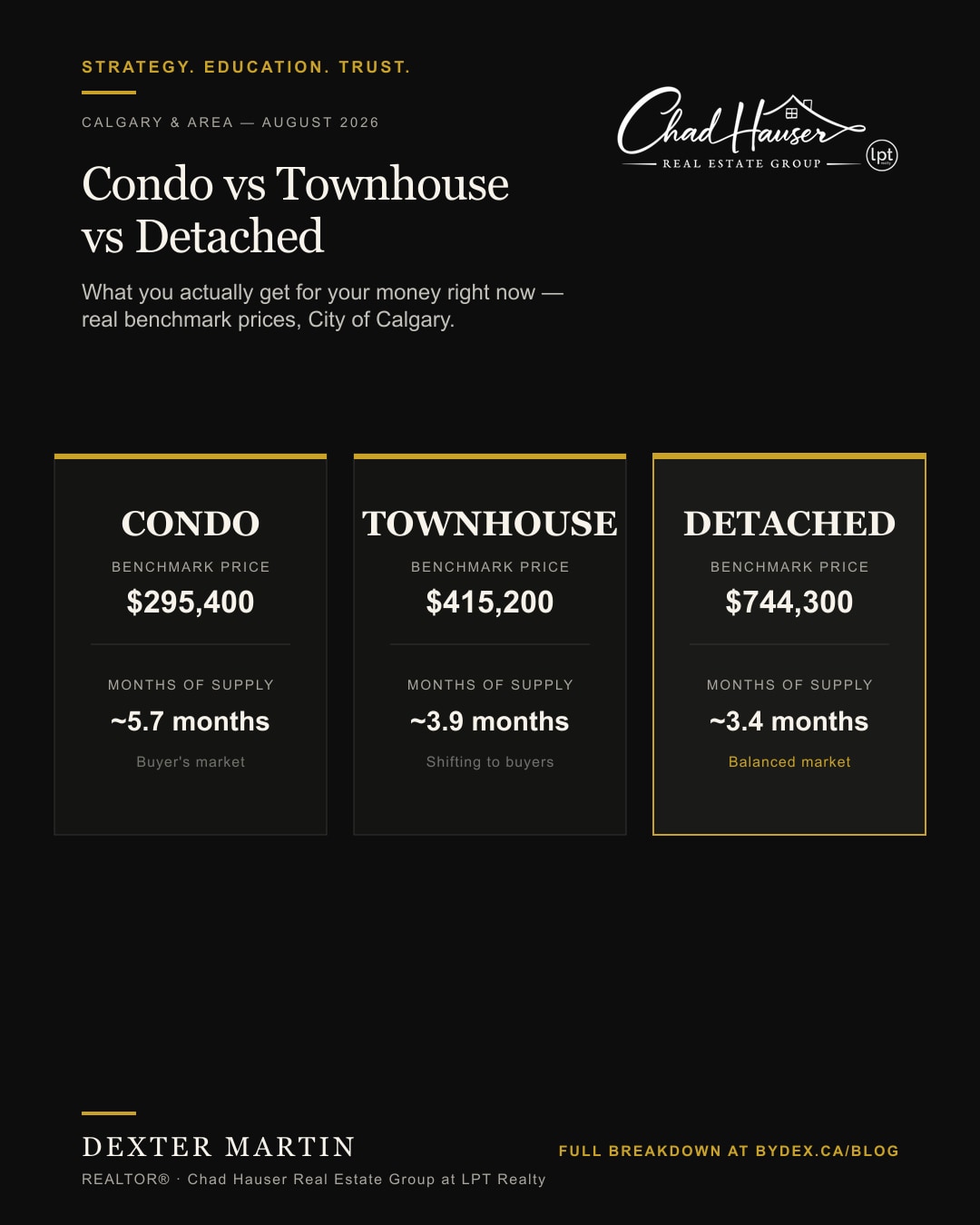
- Detached: $744,300 (down about 1% year-over-year), 3.4 months of supply — a relatively balanced market
- Semi-detached: $690,500 (up about 1% year-over-year), 3.3 months of supply — also balanced
- Row/townhouse: $415,200 (down about 5% year-over-year), 3.9 months of supply — starting to favour buyers
- Apartment/condo: $295,400 (down about 8% year-over-year), nearly 5.7 months of supply — clearly a buyer's market
That's a roughly $449,000 gap between the average condo and the average detached home in this city. That gap is the whole conversation.
Condo: The Lowest Barrier to Entry
What you get: the lowest price point by a wide margin, often the best location-for-dollar in the inner city, no exterior maintenance, and amenities you'd never afford to build yourself (gyms, rooftop patios, concierge in some buildings).
What it actually costs: condo fees. This is the number first-time buyers underestimate the most. Depending on the building and amenities, fees commonly run anywhere from $300 to $700+ per month — and that's a cost that never builds equity, on top of your mortgage. A “cheap” condo with high fees can end up costing close to what a townhouse would.
The market right now: with nearly 5.7 months of supply and prices down about 8% year-over-year, this is genuinely a buyer's market for condos. There's real room to negotiate, and more selection than there's been in years.
Who it fits: buyers prioritizing location and price over space, people who travel often and don't want exterior upkeep, and buyers using a condo as a stepping stone — build equity for 3–5 years, then move up.
The catch: read the condo board's financials and reserve fund study before you buy, not after. An underfunded reserve fund means a large special assessment bill could land in your lap later — sometimes tens of thousands of dollars, split among owners. This is one of the few places in real estate where the paperwork actually matters as much as the unit itself.
Townhouse: The Middle Ground
What you get: more space than a condo, often a small yard or patio, sometimes a garage, and — critically — you're only about $415,200 in versus $744,300 for detached. You get a real sense of “my own place” without condo-style shared hallways.
What it actually costs: many townhouses still carry a condo fee (for shared roads, snow removal, landscaping, sometimes shared walls or roofs), just usually lower than a high-rise condo — often $150–$350/month depending on the complex. Still a real ongoing cost to factor in.
The market right now: with just under 4 months of supply and prices down about 5% year-over-year, conditions are starting to favour buyers here too, though less dramatically than condos.
Who it fits: buyers who want a family-friendly layout and some outdoor space without detached-home maintenance or price, and buyers who've outgrown a condo but aren't ready (or don't want) to stretch to detached.
The catch: shared walls mean noise is a real consideration — visit at different times of day if you can. And because you're often part of a condo corporation even in a townhouse, the same reserve-fund due diligence applies.
Detached: The Most Expensive, The Most Control
What you get: full ownership of the lot, no condo fees, no shared walls, room to renovate or add on, and typically the strongest long-term appreciation of the three, especially in established or gentrifying neighborhoods.
What it actually costs: everything. The roof, the furnace, the fence, the sewer line — all you, all the time. Budgeting 1–2% of the home's value annually for maintenance and repairs is a reasonable planning number, which on a $744,300 home is $7,000–$15,000 a year in a bad year.
The market right now: at 3.4 months of supply, detached remains relatively balanced — not a steep buyer's market, but not the seller's market it was a few years ago either. Real negotiating room exists, just less than in condos.
Who it fits: buyers with a stable, larger down payment, people planning to stay long-term or start a family, and anyone who specifically wants full control over their property without shared-ownership dynamics.
The catch: the entry price is real. Getting to detached-home affordability sometimes means a longer timeline, a smaller starter home in a less “hyped” neighborhood, or accepting a home that needs cosmetic work in exchange for a lower price.
The Math First-Time Buyers Miss
It's tempting to compare purchase price alone. Don't. Compare total monthly cost — mortgage payment, property tax, condo fees (if any), insurance, and a realistic maintenance budget. Sometimes a townhouse with a $200/month condo fee actually costs more per month than a slightly pricier home with no fee at all, once everything is accounted for.
The “cheapest” option on paper isn't always the cheapest option once you add up everything you'll actually pay every month.
It's also worth asking: what does this property type do for your five-year plan? A condo bought as a deliberate stepping stone, with a clear plan to build equity and move up, is a completely different decision than a condo bought because it's simply what fit the budget with no plan beyond that.
A Simple Way to Decide
- Set your realistic total monthly budget — including fees, tax, insurance, and maintenance, not just mortgage.
- Decide how much space and privacy actually matter to you in the next 5 years, honestly.
- Check the condo/townhouse reserve fund and financials before falling in love with a listing.
- Ask whether this purchase is a long-term home or a stepping stone — both are valid, but they lead to different property types.
- Run the numbers on all three property types for the same budget, not just the one you assumed you wanted.
Ready to Compare Your Real Options?
The right property type depends on your budget, your timeline, and how you actually want to live — not a rule of thumb. I can pull current listings across all three types at your price point so you can see exactly what the tradeoffs look like in real homes, not just averages.
DM me or book a consultation call. Let's figure out which one actually fits your life.
